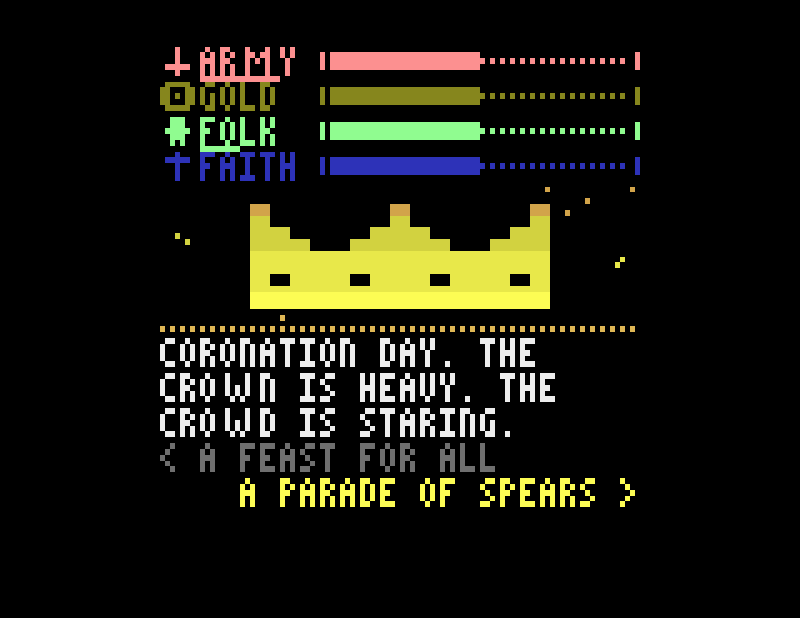
The Uneasy Crown
The old king is dead. The crown is yours. So are his enemies.
ARMY · GOLD · FOLK · FAITH
A SwipeVerse cartridge for the Atari 2600
Six small worlds on one Atari 2600 cartridge. A card asks a question. You answer left or right. Every answer costs you something, and some of them come back.
Rule a kingdom, run a block of a neon city, be a cat, survive an internship with a supervillain, deliver a pizza to Neptune, or spend 1983 as a game cartridge nobody is buying.
128K, cartridge type 3E. For Stella, or a Harmony, UnoCart or PlusCart cartridge.
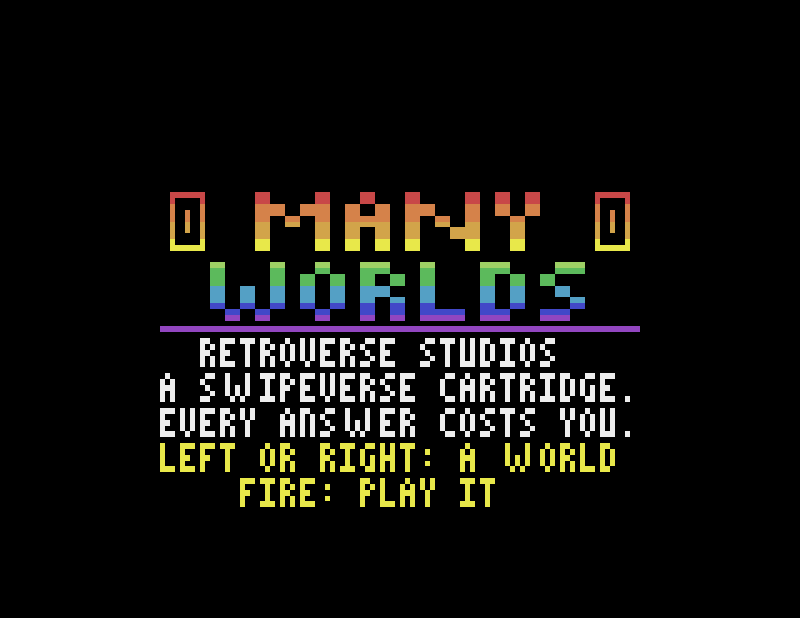
Press POWER ON, then click the picture so it hears the keys. The left and right arrows turn through the worlds and pick answers. Space is the fire button.
The emulator is Stellerator, by Christian Speckner. Open the player by itself.
Each world is a deck of 20 or so cards, and a run shows about eleven of them. Each has its own four stats, eight ways to lose and three good endings.
The old king is dead. The crown is yours. So are his enemies.
ARMY · GOLD · FOLK · FAITH
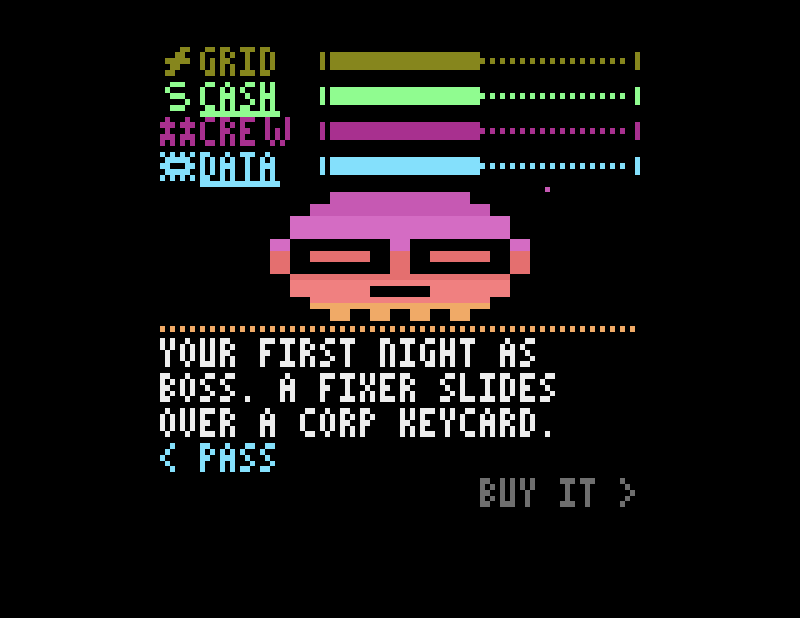
The corps own the city. You own one block, a deck and a grudge.
GRID · CASH · CREW · DATA
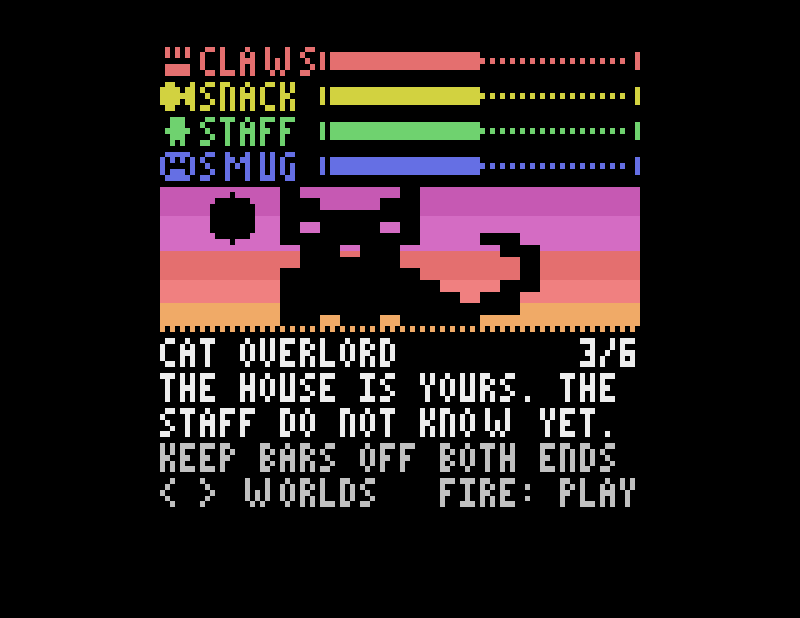
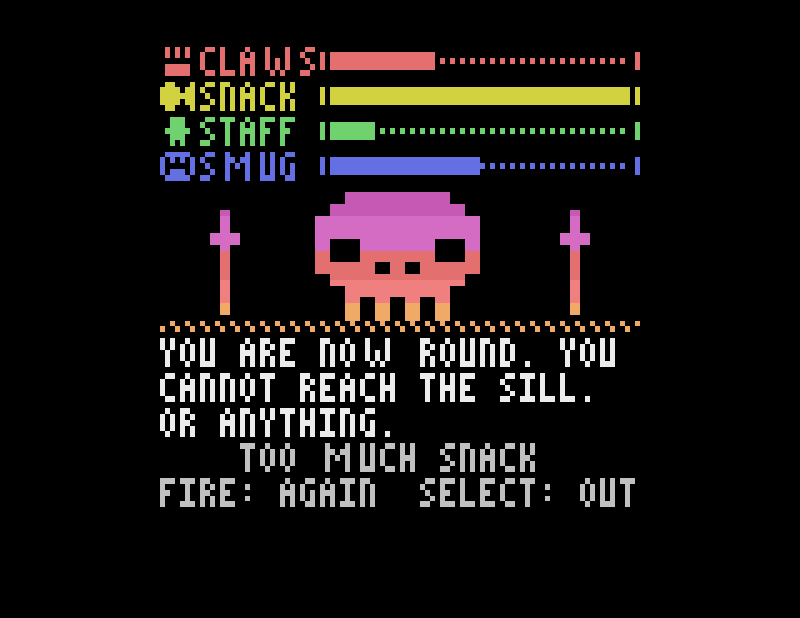
The house is yours. The staff do not know yet.
CLAWS · SNACK · STAFF · SMUG
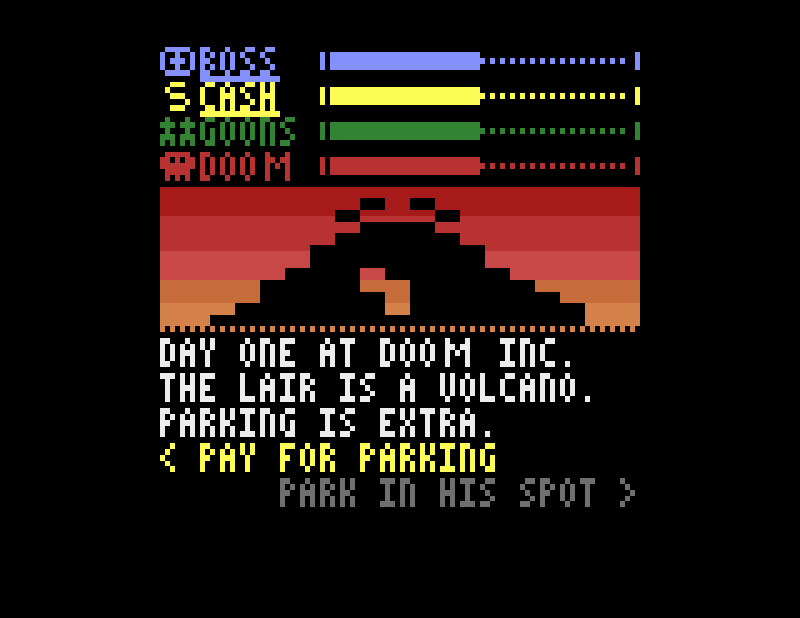
Your first job. The boss is a supervillain. The coffee is free.
BOSS · CASH · GOONS · DOOM
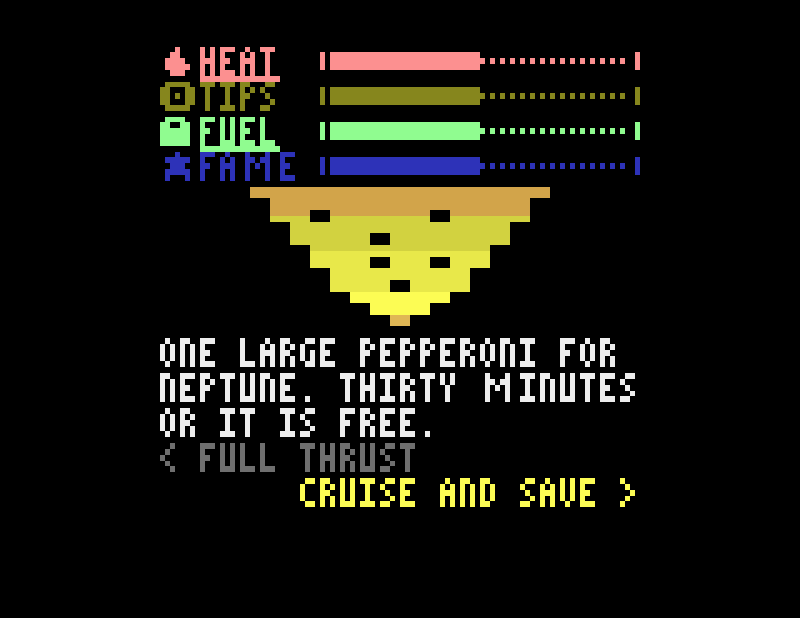
One large pepperoni for Neptune. Hot, on time, and in one piece.
HEAT · TIPS · FUEL · FAME
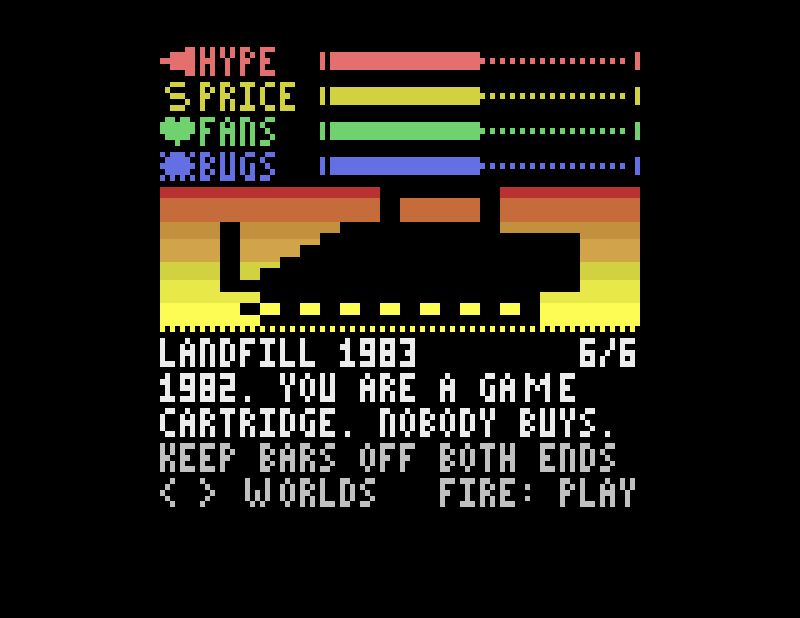
1982. You are a game cartridge. Nobody buys.
HYPE · PRICE · FANS · BUGS
Four bars sit at the top of every card, each in its own colour. They start half full. Push the joystick left or right to pick an answer. It lights up, and so do the bars it will move, with a dash under each name: short for a little, long for a lot. Nothing says which way. That part is in the words.
Fire commits. Run a bar down to nothing and the run is over. Fill a bar and the run is over too. Too much gold brings a dragon. A bar close to either end flashes white.
Your answers steer the story. Which card comes next depends on every answer so far, so the same answers tell the same tale and one changed answer tells another. Some answers come back: spare the witch, and she may turn up later with a cure.
| Choosing a world | In a run | |
|---|---|---|
| Left, right | The next world | Pick an answer |
| Fire | Play it | Commit the answer |
| RESET | The title | The deck again |
| SELECT | Leave, back to the worlds |
In the player above, Shift+Space is SELECT and Shift+Enter is RESET. The manual has the rest.
A deck is a folder with one text file and a few pictures of 96 by 25 pixels. Drop it in decks/, run make, and the cartridge has another world. The 128K cartridge has room for about five more.
An answer can set a flag, and a later card can need it. That is all it takes to make a choice come back. The build checks every line fits the screen and plays 3,000 runs to see that every card turns up. A second tool plays each deck 8,000 times to see whether it is fair.
[[card]]
id = "witch"
art = "faith"
text = "A WITCH IN THE FOREST CURES THE SICK."
left = ["PROTECT HER", "FOLK+3 FAITH-4", "set:witch"]
right = ["HAND HER OVER", "FAITH+3 FOLK-3"]

[[card]]
id = "witch-cure"
needs = "witch"
text = "THE WITCH YOU SPARED IS BACK."
...
How it works, with the measurements.
Many Worlds is a small relative of SwipeVerse, a card game for the browser with the same rules and much longer cards. Michael Borck had the idea and set the direction. The code, the decks, the pictures, the tests and this page were written with Claude, an AI model made by Anthropic, working in Claude Code, on 29 November 2026.
It is built on the Atari lab kit, the framework under Hands-on AI Lab.
What has been checked: a test plays every deck through twice in a cycle-exact model of the 6507, beside a Python copy of the rules, and compares every card chosen, word, bar, picture and stat. Every frame is 262 lines. What has not: nobody has run it on a real console yet, played the decks through by hand, or sat and listened to the sound.